
Exploring composition mixing in kilonova ejecta with ray-by-ray simulations
Binary neutron star mergers (BNSMs) are a primary site for forging the universe’s heaviest elements. A natural question is whether the internal “stirring” of the ejected material — the mixing of isotopes between different regions — meaningfully changes the elements produced and the light we ultimately observe from Earth.
In this work, I studied composition mixing in ray-by-ray simulations, where the ejecta is modeled as a series of independent angular slices, each with radial gradients in its composition. I implemented a new mixing scheme directly into the radiation-hydrodynamic simulations, coupled to an online nuclear network, so that composition and hydrodynamics evolve simultaneously and the migration of isotopes can be tracked as the ejecta expands.
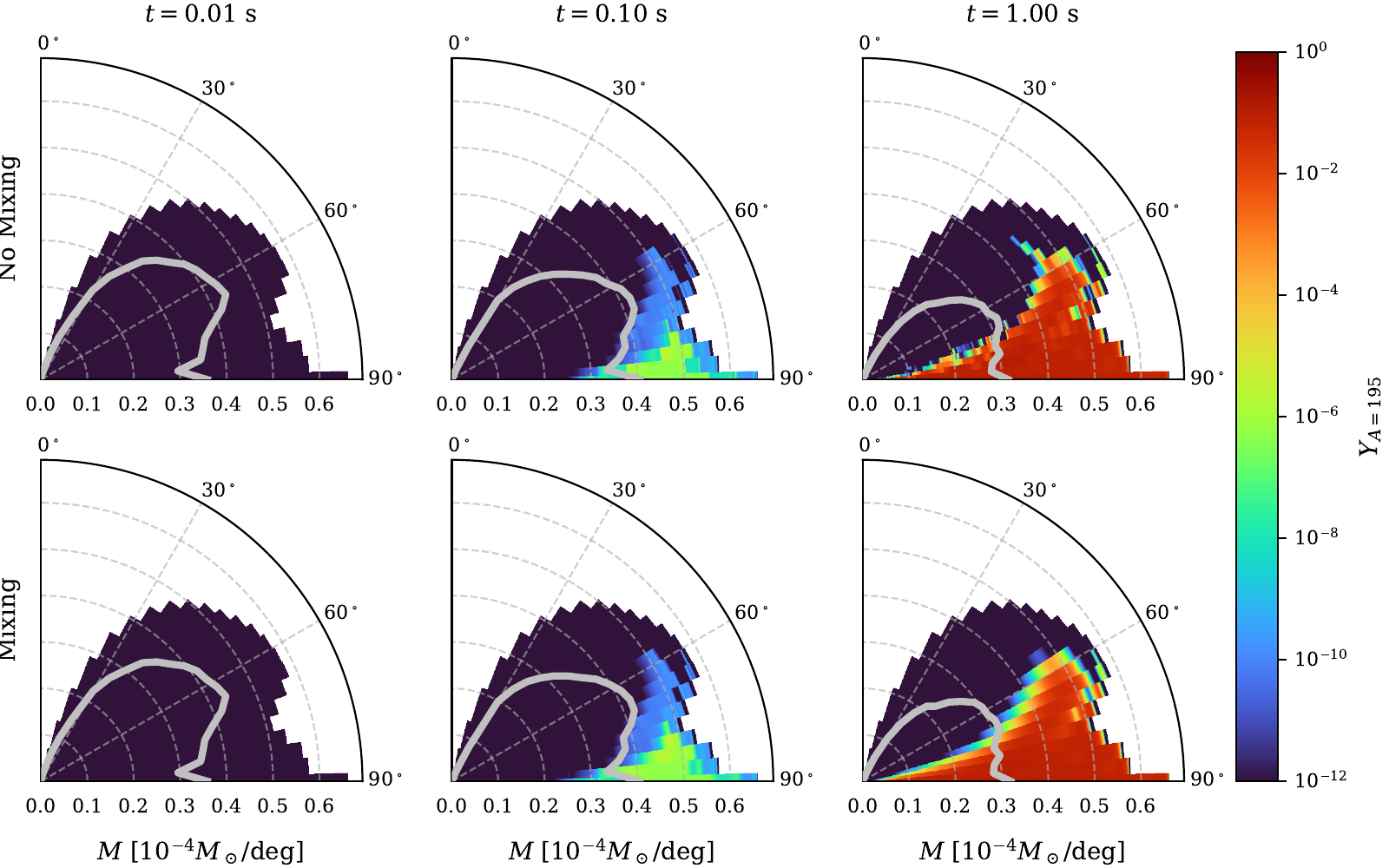
I find that although mixing is active in transition regions — where the electron fraction changes rapidly, near polar angles of 60° — its effect on the final heavy-element yields is negligible. The main r-process site, the equatorial ejecta, begins essentially homogeneous in free neutrons; with no strong initial gradients for mixing to act on in these neutron-rich regions, the production of the dominant species remains robust. The impact on kilonova light curves is likewise small: the models show only minor reddening in the infrared bands, well below the detection limits of current state-of-the-art telescopes.
Read the full study in Physical Review D. arXiv: 2601.02600.